How to Continuously Learn and Grow in Your Career
How to keep growing in the job you have: goals with real steps, a development plan you review, stretch projects, useful feedback, and mentors at work.

The best classroom you have is probably the job you already do. Every week it hands you real problems, people with more experience than you, and a manager who decides what you work on next. Most people use only a small part of that. They do good work, wait for a promotion conversation, and wonder why a year went by without much change.
Growing on the job is mostly a set of habits: knowing where you’re headed, asking for work that stretches you, getting honest feedback, and reviewing your progress often enough to adjust. Here’s how to build each one, plus how to keep the pace sustainable.
Set a goal and break it into steps
Start with where you want to be in a few years. Think about the kind of role you want, how much responsibility you’d like, and the kind of impact you want to have. “Grow in my career” isn’t a goal. “Move into a team lead role” is.
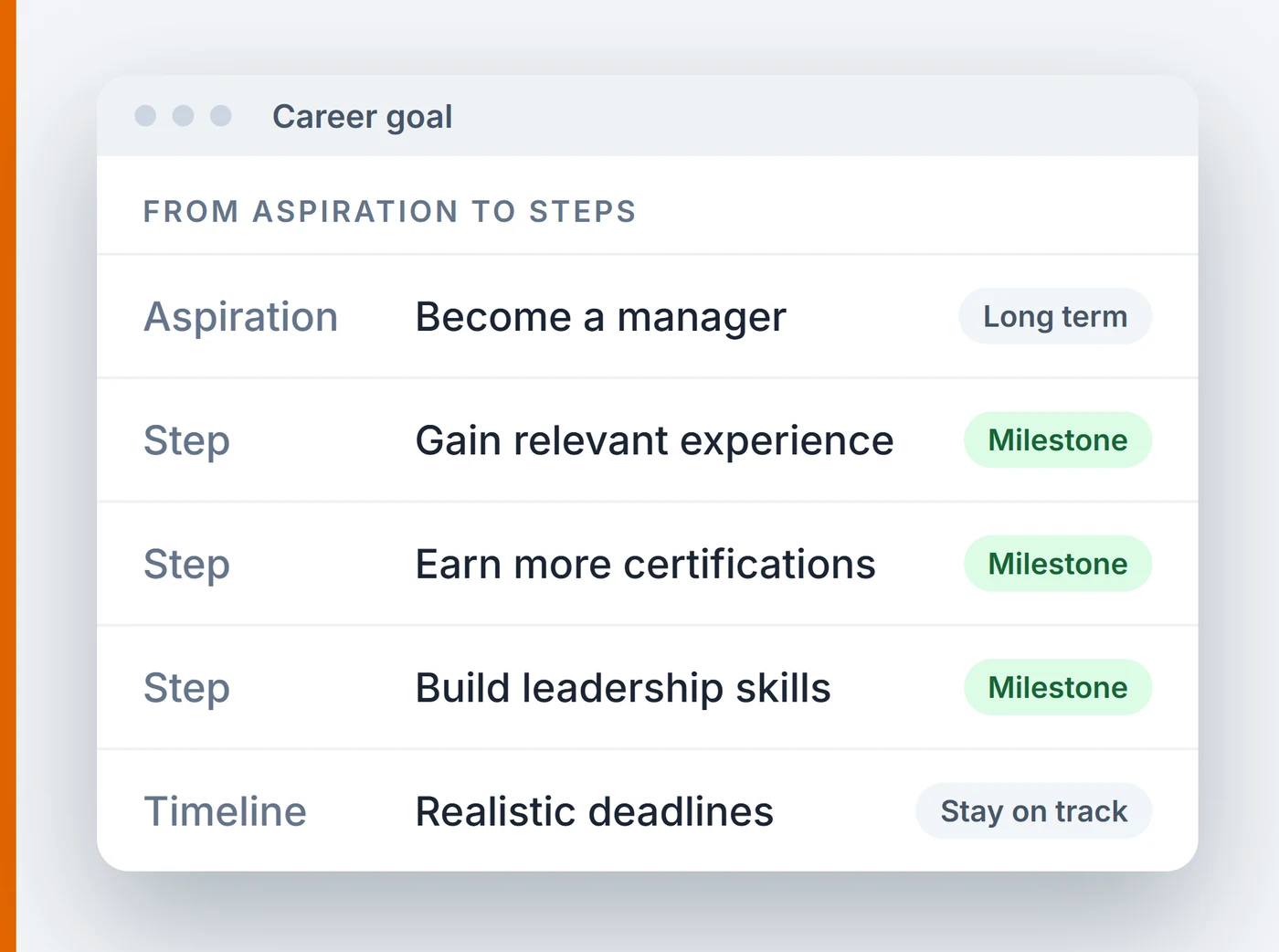
A big goal is hard to act on, so break it into steps you could start this month, and give each one a realistic deadline. Here’s how “become a manager” might look over six months:
- Month 1: Tell your manager you want to move toward a management role, and ask what they’d need to see from you first.
- Months 1 to 2: Get relevant experience in small doses. Run the weekly team meeting, or take over the status report.
- Months 2 to 4: Lead one small project from start to finish, including the planning and the follow-up.
- Months 3 to 5: Earn a certification that matters in your field, if the roles you’re aiming for ask for one.
- Months 4 to 6: Build leadership skills on purpose. Help onboard a new hire and ask for feedback on how you handled it.
Be realistic about timing. A deadline you keep missing teaches you to ignore deadlines. Better to set six months and finish in five than set three and give up in four.
Write a personal development plan you’ll actually review
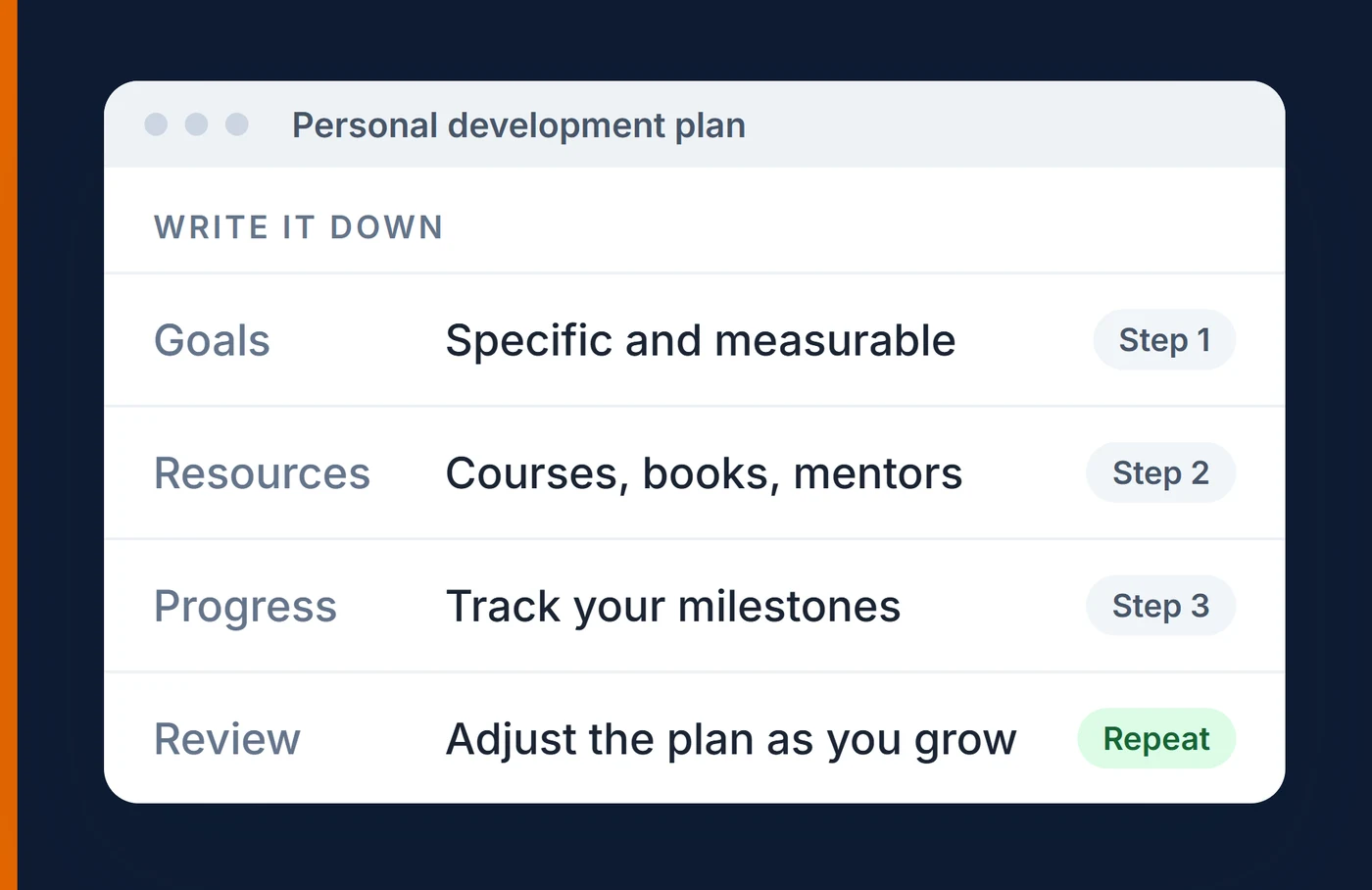
A goal in your head fades. A short written plan keeps it in front of you, and one page with five parts is enough:
- Goal: Present to clients on my own by the end of next quarter.
- Skills: Structuring a presentation, handling questions live, staying calm when a meeting goes off script.
- Actions: Present the monthly update to my team. Co-present at two client meetings with my manager. Ask for feedback after each one.
- Resources: My manager, a colleague who presents well, one book or short course on presenting.
- Check-in date: The first Monday of every month.
The check-in date is the part most people skip, and it’s the part that makes the plan work. Put it on your calendar. When it comes up, spend fifteen minutes on three questions: What did I finish? What got in the way? What should change? Then update the plan.
Plans should change as your goals do. Adjusting the plan isn’t failing at it. Never looking at it again is.
Ask for stretch projects
A stretch project is work a little beyond what you can comfortably do today, like leading something you’ve only helped with before. It’s where most on-the-job growth happens, because you can’t coast through it.
Managers don’t always offer these, so ask, and make it easy to say yes. Name a specific project, say why you want it, and show you’ve thought about your current workload. For example:
“I’d like to take on more ownership of our vendor relationships. The vendor review coming up next quarter looks like a good fit. Could I lead it, with you checking in at the halfway point? I can keep my current work on track by moving the weekly report to Friday afternoons.”
A specific request like that is much easier to approve than “I’d like more responsibility.” If the answer is no, ask what would make it a yes next time.
Expect the project to feel uncomfortable. That’s the point. Ask questions early, update your manager before they have to ask, and treat mistakes as part of learning.
Build skills on real work
You develop a skill by using it, not by reading about it. The fastest way to improve is to find a piece of your real work where you can practice, preferably somewhere a mistake is cheap.
Take an honest look at your current skills, both the technical ones and soft skills like communication, leadership, and problem-solving. Pick one gap that matters for your goal, then find a way to use it this month:
- Want to get better at writing? Volunteer to draft the next project summary.
- Want to understand the numbers? Ask to build part of the monthly report.
- Want to manage people someday? Offer to train the next new hire.
Personal projects outside work count too. What matters is using the skill again and again.
Courses, certifications, conferences, industry blogs and networking events have a place, especially when your job can’t teach you something or the role you want requires a credential. Our post on why lifelong learning is your secret weapon covers how to choose among them and fit them into a busy schedule. The habit here is to bring whatever you learn back to real work quickly, while it’s still fresh.
Ask for feedback that’s specific enough to use
“Do you have any feedback for me?” almost always gets “No, you’re doing great.” It’s too broad, and it puts the other person on the spot. Ask a narrow question right after a specific piece of work instead:
“What’s one thing I could have done better in that presentation?”
One thing is easy to answer honestly, and asking right away means the details are still fresh. Ask colleagues and your manager, not just people who’ll be polite, and ask often so it stops feeling like a big event.
When the answer stings, don’t defend yourself. Say thank you, ask one follow-up question if something is unclear, and think about it later. People who get defensive stop getting honest feedback.
Feedback is only useful if you act on it. Pick one point, add it to your development plan as an action, and try a change on the next similar piece of work. A few weeks later, go back to the same person: “You mentioned I rushed the last section. Did that feel better this time?” That makes them more likely to be candid next time. If the same comment keeps coming up from different people, it may be a blind spot. Our post on career blind spots covers how to find and work on those.
Find a mentor inside your company
A mentor at work can teach you things nobody writes down: how decisions really get made, which projects get noticed, and what the people above you care about. Look for someone a level or two ahead of you, or in a different team whose work you’d like to understand. They should be approachable and have skills you want to build.
You don’t need to ask “Will you be my mentor?” That can feel like a big commitment. Ask for one conversation about something specific:
“I’m working toward leading projects on my own, and I’ve noticed how well your team’s launches go. Could I buy you a coffee and ask how you plan them?”
If it goes well, ask to meet again in a month, and over time agree on how often you’ll meet and what you want from it. Come to each meeting with a real question or situation, not just an update, and tell them later what you did with their advice.
Mentoring works both ways, so offer help with their projects when you can. For more on building these relationships, see our networking strategies guide.
Keep the pace sustainable
Growth that burns you out doesn’t last. If every evening goes to extra projects and every weekend to catching up, you’ll stall, and your current work will suffer too.
Work on one goal at a time. One development goal you make real progress on beats four you keep pushing back.
Block time for it. Put an hour or two a week on your calendar for practice, reading, or planning, and protect it like a meeting with your manager.
Say no to the wrong stretch. A stretch project you have no time for helps no one. It’s fine to ask to start it next month instead.
Protect your time off. Exercise, sleep, hobbies, and time with people you care about aren’t a break from growing. They give you the energy to keep at it. Set clear boundaries between work and the rest of your life.
Start small. This week, write down one goal, break it into three or four steps, and put your first check-in date on the calendar.