10 Resume Mistakes You Didn't Know You're Making
Ten resume mistakes that quietly cost you interviews, from bullets that list duties to a LinkedIn profile that doesn't match, with a fix for each.

Most resumes that don’t get callbacks aren’t full of typos. They’re accurate and tidy, and they say very little. The reader can see where you worked but not what you did there, or why you fit this job in particular. Those are the hardest mistakes to spot in your own resume, because nothing on the page looks wrong.
Here are ten that cost people interviews, starting with the least obvious, and how to fix each one.
1. Your bullets say what you were responsible for, not what you did
A job description lists duties. Your resume shouldn’t. When every bullet starts with “Responsible for,” the reader learns what the job was, which they could guess from the title, and nothing about how well you did it.
Rewrite each bullet around an outcome. What changed because you were there? Did you increase sales, save time or money, or finish a difficult project on schedule? Then add the number if you have one:
- Before: “Responsible for managing key client accounts.”
- After: “Managed 12 key client accounts and increased sales by 15% within the first quarter.”
If you don’t have a percentage, use figures you can stand behind: team size, budget, number of customers, turnaround time. An award or a project delivered under budget counts too. Our resume writing guide walks through turning a list of duties into results.
2. Your summary could belong to anyone
The summary is the first thing a reader takes in, and many people fill it with a sentence that would fit any candidate for any job:
Hardworking, motivated professional seeking a position where I can use my skills and grow with a great company.
It tells the reader nothing about you, and an objective that talks about what you want from the job does even less. Replace it with two or three lines that say what you do, at what level, and what you bring to this role:
Operations coordinator with four years in warehouse logistics. Redesigned the picking checklist to cut order errors and trained new hires on the inventory system.
Rewrite it for each kind of role you apply for. If your summary could be pasted onto a coworker’s resume without changes, it isn’t specific enough yet.
3. You describe yourself with words everyone uses
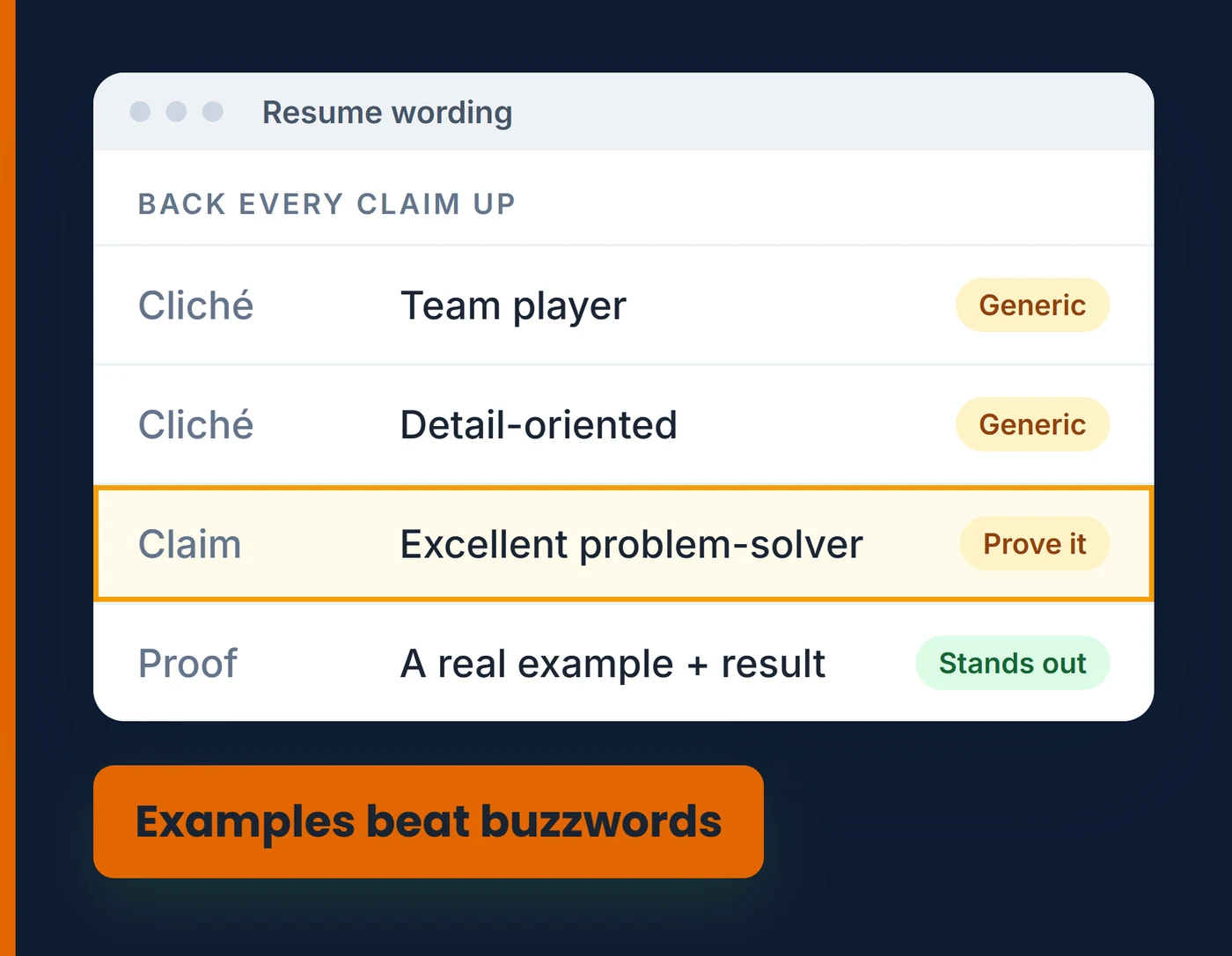
“Team player,” “detail-oriented,” “strong communication skills,” “excellent problem-solver.” These phrases appear on so many resumes that the reader’s eye slides past them. A page packed with buzzwords can also read as if there’s nothing underneath.
Treat each one as a claim that needs evidence, then keep the evidence and drop the label:
- Claim: “Excellent problem-solving skills.”
- Proof: “Traced a recurring billing error to its source and fixed it, ending a steady stream of customer complaints.”
Industry terms are fine where they accurately describe your work. Use them the way you would with a colleague: inside a sentence about something you did.
4. You send the same resume to every job
One resume for every opening feels efficient, but each posting asks for something slightly different, and a generic resume matches none of them well. Read the job description closely and adjust your resume so the skills and experience it asks for are the first things the reader sees.
Keywords matter here too. Many employers use an applicant tracking system (ATS) to scan resumes for words and phrases from the job posting, and a resume without them can be filtered out before a person reads it. Note the titles, tools, and skills the posting repeats, and where you genuinely have them, use the same words. If the posting says “budget forecasting,” don’t only say “financial planning.” Work those terms into real bullets, not a block of keywords at the bottom. Our guide to how recruiters really read your resume covers what the software and the first human read look for.
5. Your resume still carries things that stopped helping you
Resumes grow by addition. Each new job goes on top and nothing comes off, so the page fills up with roles from early in your career, certifications that have lapsed, hobbies, and a skills list covering everything you’ve ever touched.
All of that takes space and attention away from the parts that make your case. Before anything stays, ask whether it helps show you can do this job:
- Old roles: keep the ones that support where you’re heading, and cut or shorten the rest.
- Hobbies and interests: leave them off unless they relate directly to the role.
- Skills: list the ones the job calls for, not every program you’ve opened.
- Certifications: drop lapsed or unrelated ones, and give relevant ones in full: the title, the institution or organization, and the date you completed it. Courses finished since your degree count.
If you’re early in your career or changing fields, the same test works in the other direction. A relevant internship, volunteer role, or piece of coursework can earn a place over an unrelated job.
6. Your best material is buried
A reader’s first look at a resume takes only a few seconds, so what sits at the top matters most. If your strongest experience is hidden in long paragraphs, or on page two behind older roles, it may never get read.
Put your most relevant and recent experience first, and lead each role with its strongest bullet. Write in short bullets instead of paragraphs, and cut words that don’t add meaning:
- Before: “In this position I was given the opportunity to take part in a variety of different initiatives aimed at improving the efficiency of the team’s internal processes.”
- After: “Rebuilt the team’s request tracker, cutting the weekly status meeting from an hour to 20 minutes.”
The second version is shorter and says more. Do that to every bullet and the page gets easier to scan without losing anything.
7. Your resume and your LinkedIn profile tell different stories
Employers may look you up while they consider your application, and LinkedIn is usually where they land first. If your job titles, dates, or qualifications don’t match between the two, it raises doubts about which version is accurate, and you won’t be there to explain.
Put your resume and your profile side by side and make the facts identical: titles, employers, dates, degrees, certifications. Then update the profile with your recent experience and accomplishments, and remove anything outdated or unprofessional from your public social media accounts. Our LinkedIn profile tips go through the profile section by section.
8. Your formatting changes halfway down the page
Small inconsistencies are easy to miss in a resume you’ve edited for years: a second font pasted in from an old version, bullets that switch style, dates written two different ways, a heading slightly out of line. Together they make the page look careless and harder to scan.
Pick one of each and apply it everywhere:
- One font, in one size for body text (headings can be larger).
- One bullet style, with the same indentation under every role.
- One date format for every role.
- Bold and italics used sparingly, and for the same things each time, such as job titles.
- The same alignment, margins, line spacing, and white space between sections.
9. Your contact details work against you
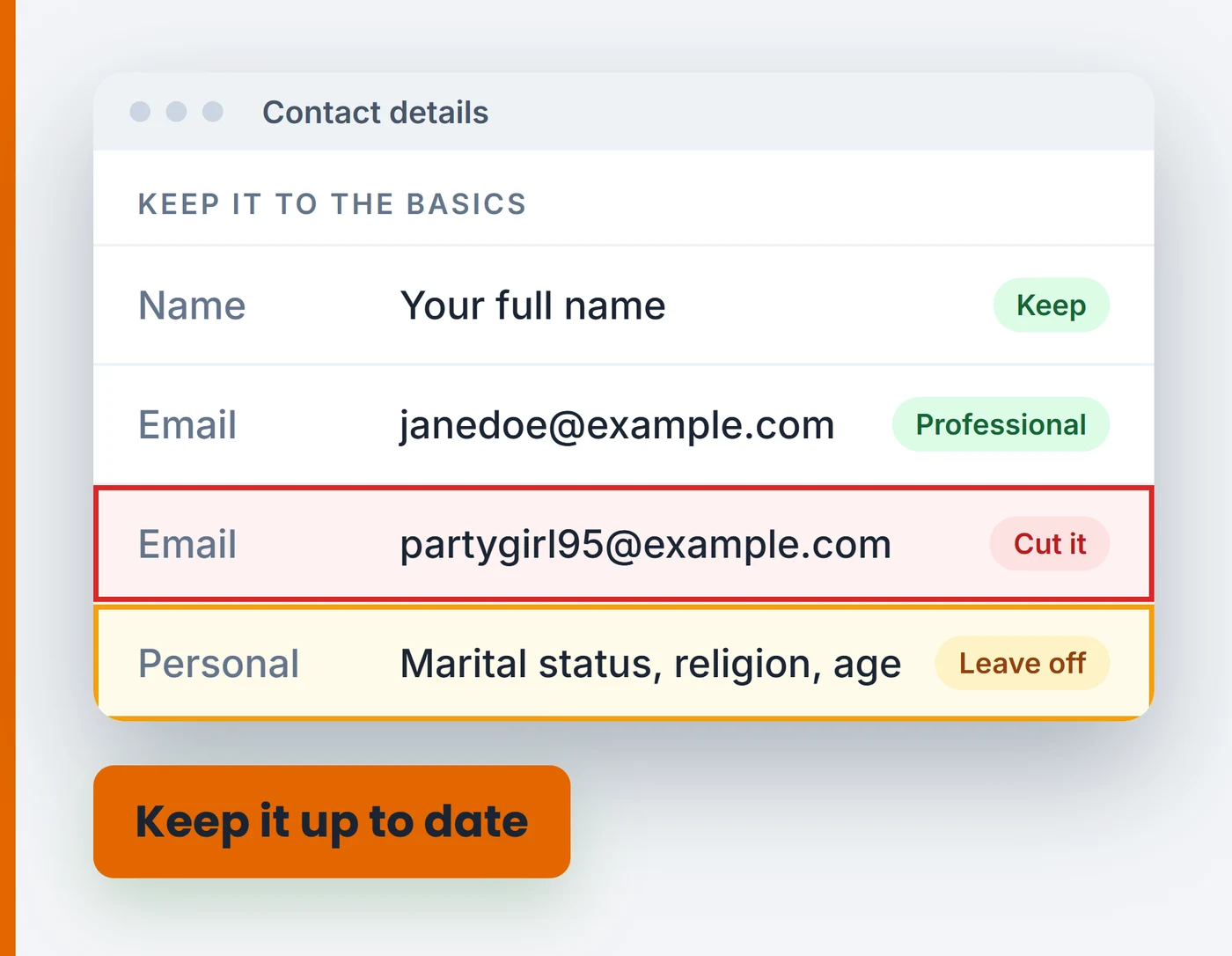
The top of your resume should let an employer reach you, and nothing more: your full name, current phone number, a professional email address, and your LinkedIn profile if it’s relevant to the job. Personal details such as marital status, religion, or age don’t belong there. They pull attention away from your skills and qualifications.
Your email address is one of the first things an employer sees. An address like partygirl95@example.com or rockstar123@example.com makes a poor impression before anyone reads your experience. Set up a separate address for your job search that uses your name, such as janedoe@example.com.
Then check that every detail is current. If you’ve changed your phone number or email, an old one on your resume can mean an employer who wanted to schedule an interview can’t reach you.
10. You trusted spell-check to proofread it
Spell-check catches misspelled words. It doesn’t catch a real word in the wrong place (“manger” for “manager”), a sentence missing its verb, or a job title capitalized two different ways. Errors like these suggest a lack of care, in a document you had all the time you wanted to check.
Run spell-check first, then proofread the resume yourself more than once. Read it aloud, since your ear catches what your eye skips. Then ask someone else to read it. A friend, mentor, or proofreader will see the mistakes you’ve stopped noticing.
Before you send it
Pick one job you want right now and read your resume against its posting. Start with the top: does your summary say why you fit this role? Then go bullet by bullet and ask what each one proves. Fix those two things before you worry about fonts. They’re the mistakes nobody will point out to you.