What Hiring Managers Wish You Knew About Job Interviews
The four things a hiring manager is trying to decide in an interview, and what they listen and watch for while you answer.

When an interview ends, the hiring manager has to answer four questions about you. Can you do the job? Do you really want this job? Will you work well with the team? And is there any reason to worry about hiring you? Every question they ask, from “Tell me about yourself” to “Any questions for us?”, is a way of getting at one of those four.
Here’s what the person on the other side of the table is listening and watching for. For the preparation itself (research, practice, what to bring, and the STAR method), see our complete guide to acing your next job interview.
It starts before the first question
Before you’ve said a word about your experience, the hiring manager has noticed whether you arrived on time and whether you look like you took the meeting seriously. None of that decides the outcome, but it sets the frame. A candidate who arrives flustered and late spends the first part of the interview recovering. One who arrives a little early, calm and ready, starts with the benefit of the doubt.
Punctuality reads as respect for their time and as a preview of how reliable you’ll be. If something goes wrong on the way, call or email as soon as you know you’ll be late. A short heads-up turns a red flag into a minor inconvenience. Silence is much harder to recover from.
Can you do the job?
Most of the interview is built around this question. The hiring manager has a list of what the role needs, usually close to the job description, and they’re checking your experience against it.
What they listen for is the connection. A general answer leaves them to work out whether you fit. A tailored answer does that work for them. Compare two answers to “Tell me about your project management experience”:
- Weak: “I’ve managed lots of projects in my career, and I’m very organized.”
- Strong: “Your posting mentions coordinating launches across several teams. In my current role I ran our last product launch with design, sales, and support. I kept one shared timeline everyone could check, and we hit the launch date.”
Stories beat adjectives. “Hardworking” and “detail-oriented” are claims. A short story about a problem you solved is evidence, and it’s easier to remember when the hiring manager compares candidates later.
Put a number on it when you can. Team size, budget, number of clients, time saved. If a result can’t be measured, describe what changed because of your work.
Say why it matters here. End the story by tying it back to the job: “That’s the kind of cross-team work this role seems to need.”
Do you really want this job?
A hiring manager wants to know whether you want this job or just a job. From their side, a candidate who’s interested in the work is a safer bet than one who would take any offer.
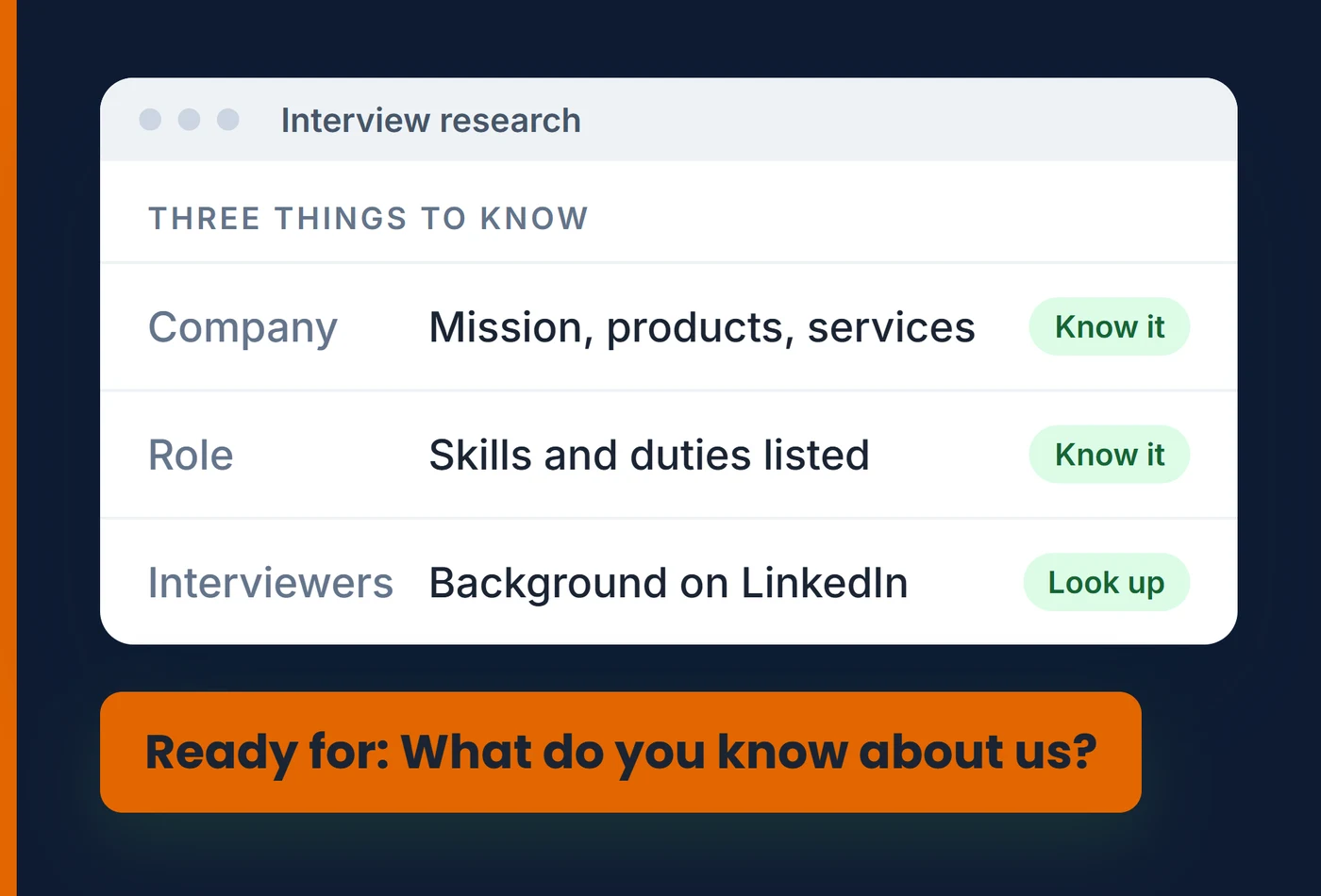
Your research shows it. “What do you know about our company?” tests whether you did your homework. Knowing the company’s products or services, its mission, and any recent news shows interest more convincingly than saying you’re interested. A quick look at your interviewers’ LinkedIn profiles helps too, so you know what they do and what they might care about.
So does your answer to “Why do you want this job?” Compare:
- Weak: “It seems like a great company, and I’m looking for my next challenge. The role is a good fit for my skills.”
- Strong: “I’ve spent three years doing customer onboarding, and the part I enjoy most is fixing the process, not just running it. This role owns onboarding for the whole company, and with your move into larger accounts, that process is going to change a lot. That’s the work I want to be doing.”
The weak answer could be said about any job. The strong one could only be said about this one.
Enthusiasm has to sound real. You don’t need to gush. Listen closely, follow up on what they tell you, and let it show when something about the work interests you. A related project you took on, or a time you went beyond what the job asked, says more about your motivation than calling yourself passionate.
Will you work well with the team?
Skills get you on the shortlist. Whether the hiring manager can picture you on their team often decides the rest. They’re watching how you talk about yourself and about other people.
Confidence, not overconfidence. Speak plainly about what you’ve achieved, without hedging every sentence. But a candidate who has an answer for everything, talks over the interviewer, or implies they’d fix the team single-handedly is someone the hiring manager will worry about managing.
Humility. Give credit where it’s due. “I led the rollout, and our analyst built the reporting that made it work” shows you know what you did and what others did.
Saying “I don’t know.” Admitting you don’t have an answer, then explaining how you’d find out, shows honesty and a willingness to learn. A bluff is usually easy to spot.
Is there any reason to worry?
The hiring manager is also looking for risks: a weakness that would cause problems in this role, or an attitude that could be trouble later. Two moments tend to bring these out.
When you talk about a weakness
“What’s your biggest weakness?” isn’t a trap. The hiring manager wants to see whether you know yourself and whether you’re doing something about it.
- Weak: “I’m a perfectionist. I just care too much about getting things right.”
- Strong: “I used to avoid presenting to large groups, which held me back once my role involved client meetings. Last year I volunteered to run our monthly team update to get regular practice, and now I present to clients without much trouble. It’s still not my favorite part of the job, but it’s no longer holding me back.”
The weak answer dodges the question, and the hiring manager can tell. The strong one names a real weakness, shows what you did about it, and ends with progress. Choose something real that isn’t central to the job.
When you talk about a past employer
Sooner or later you’ll be asked why you’re leaving. If your last job was a bad one, be careful. Whatever you say about your old boss, the hiring manager hears as a preview of what you might one day say about them.
- Instead of: “My manager was disorganized and never backed the team, so I’m getting out.”
- Try: “The team changed direction a lot, and I learned how to keep my projects moving when priorities shifted. Now I’m looking for a team with a clearer long-term plan, and from what you’ve described, this is one.”
The second is honest without being bitter, shows you learned something, and points forward.
What your questions tell them
When the hiring manager asks whether you have any questions, the interview isn’t winding down. Your questions show what you care about.
Questions about the work, the team, and how people grow there suggest you’re thinking about doing the job well and staying. A few that work:
- “What does a typical week look like in this role?”
- “What do the people who do well on this team have in common?”
- “What’s the biggest challenge the team is working on right now?”
Questions that only cover time off and perks, asked early, suggest your attention is elsewhere. Pay matters, and there’s a right time to raise it. Our guide to negotiating your salary covers when and how.
After you leave the room
The hiring manager may still have other candidates to see, so what you do next is part of how they remember you.
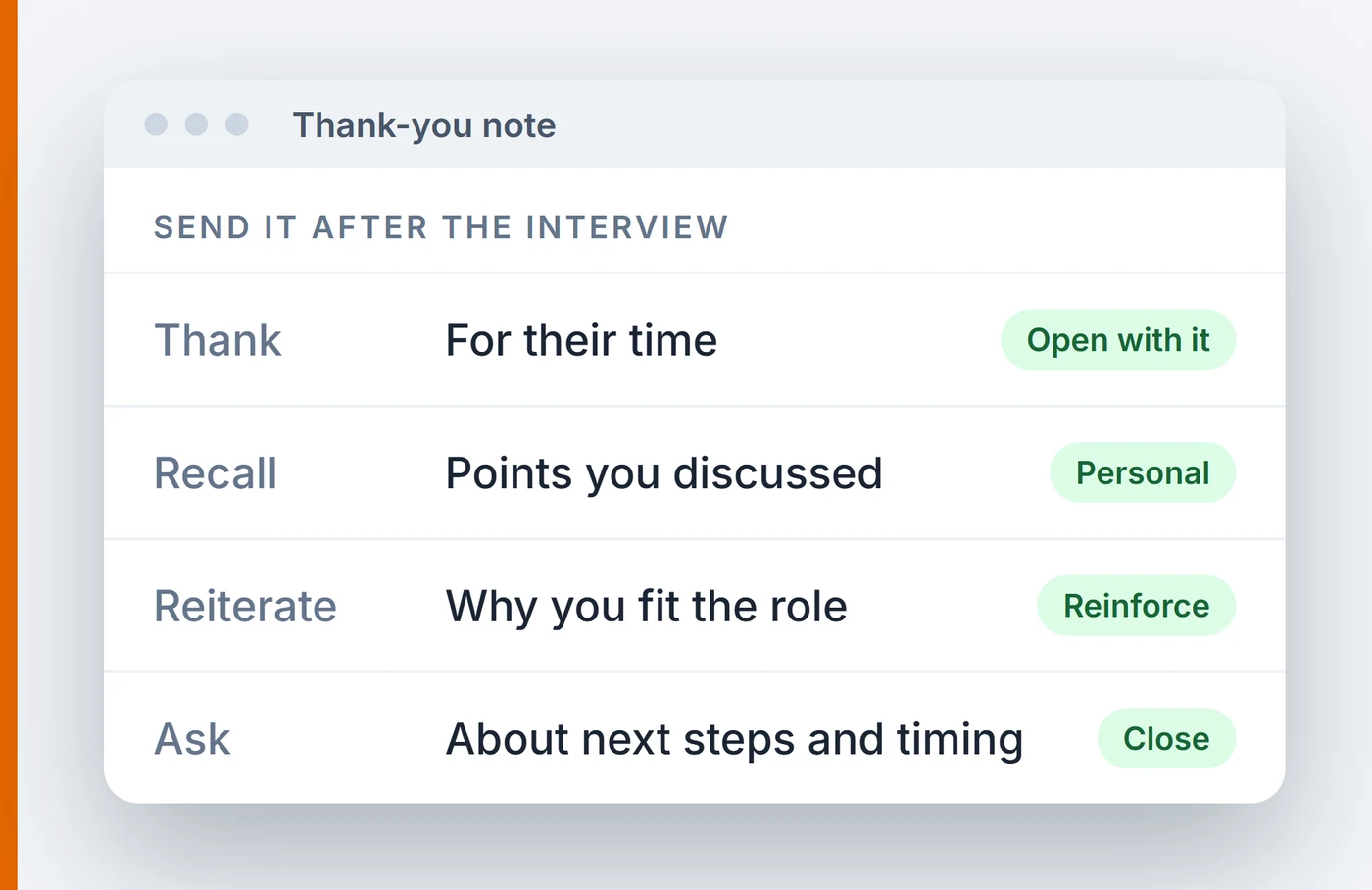
A short thank-you note, sent soon after, shows professionalism and gives you one more chance to make your case. Mention something specific you discussed, restate why you fit, and confirm you’re still interested.
Before you leave, ask about next steps and when they expect to decide. It shows you’re keen, and it tells you when a follow-up is reasonable. If the answer turns out to be no, ask whether they’d share feedback, and see our guide to turning job rejections into opportunities.
Answer their four questions
Before your next interview, check that you have something ready for each:
- Can you do the job? Two or three stories, with results, that match what the job description stresses.
- Do you really want this job? A reason that fits this role at this company and no other.
- Will you work well with the team? An example of sharing credit or taking feedback.
- Is there any reason to worry? An honest weakness with progress behind it, and a forward-looking reason for leaving.
Settle all four, and you’ve given the hiring manager what they need to say yes.