The Ultimate Guide to Acing Your Next Job Interview
A step-by-step job interview guide: research, practice, what to bring, STAR answers, questions to ask, and a sample thank-you email.

Most of what makes an interview go well happens before you walk in. The candidates who do best usually aren’t the smoothest talkers. They’re the ones who know what the job needs, have a few real examples ready, and have said their answers out loud at least once.
This guide follows an interview from start to finish: the days before, the day itself, the conversation, and the follow-up.
Research the company and the job
Start with the company, but skip the trivia. You don’t need to memorize its founding date. You need enough to explain why you want to work there and how you’d help.
An hour on these three things is usually enough:
- What it sells and to whom. Read the product or services pages and note who the customers are and what makes the offering different.
- What it says it values. Read the mission statement and values page, then pick one or two that match how you like to work. They’ll come in handy when someone asks “Why do you want to work here?”
- What’s new. Check recent news, press releases, and the company’s social media for launches, expansions, or changes. A recent project makes a good topic for a question later.
Then read the job description two or three times. Separate the required skills from the preferred ones, and list the five or six things the employer seems to care about most. Next to each one, write down a time you did that thing. That list is the core of your preparation. If the role is new to you, ask someone who does similar work what a normal week looks like.
Prepare your answers and examples
You can’t predict every question, but a few come up in almost every interview:
- “Tell me about yourself.”
- “What are your strengths and weaknesses?”
- “Why do you want to work for this company?”
Prepare a short answer to each. For “Tell me about yourself,” cover what you do now, one or two results you’re proud of, and why this role is a logical next step. Don’t recite your resume line by line.
Many interviews also include behavioral questions, which ask how you handled a specific situation in the past. They test skills like leadership, problem-solving, teamwork, and adaptability. Using your list from the job description, prepare four or five stories that show those skills, each with a clear problem, clear actions, and a result. One good story can often answer several questions. Write each as a few bullet points, not a script, so you remember its shape instead of reciting it.
Prepare your questions for the interviewer
Near the end, most interviewers ask whether you have any questions. “No, I think you covered everything” wastes the chance. Good questions show you’re serious, and the answers help you decide whether you want the job.
Three that work in almost any interview:
- “What are the top priorities for this role in the first few months?”
- “How would you describe the culture on this team?”
- “What opportunities are there to grow in this role?”
Bring a few more in case some get answered during the conversation, and add one that’s specific to the company, such as a question about a recent launch you read about. Salary usually comes later in the process. When it does, our guide to negotiating your salary can help.
Practice out loud
Answers that sound fine in your head often come out long or tangled the first time you say them. Practice them aloud, then practice again.
- Run a mock interview. Ask a mentor, career coach, or trusted friend to play the interviewer and give you honest feedback on your answers, body language, and overall presentation.
- Record yourself. Watch it back and listen for filler words, stories that wander, and a flat tone of voice.
- Use a mirror. It’s a quick way to check your expressions and posture.
The goal is to sound natural, not rehearsed.
On the day: what to bring, what to wear, when to arrive
What to wear. Match the company’s culture and industry. If you’re unsure, go one step more formal, since being slightly overdressed is better than being underdressed. Make sure your clothes are clean and your hair and nails are neat, and skip strong cologne or perfume. Choose polished, closed-toe shoes you can walk and stand in comfortably.
What to bring.
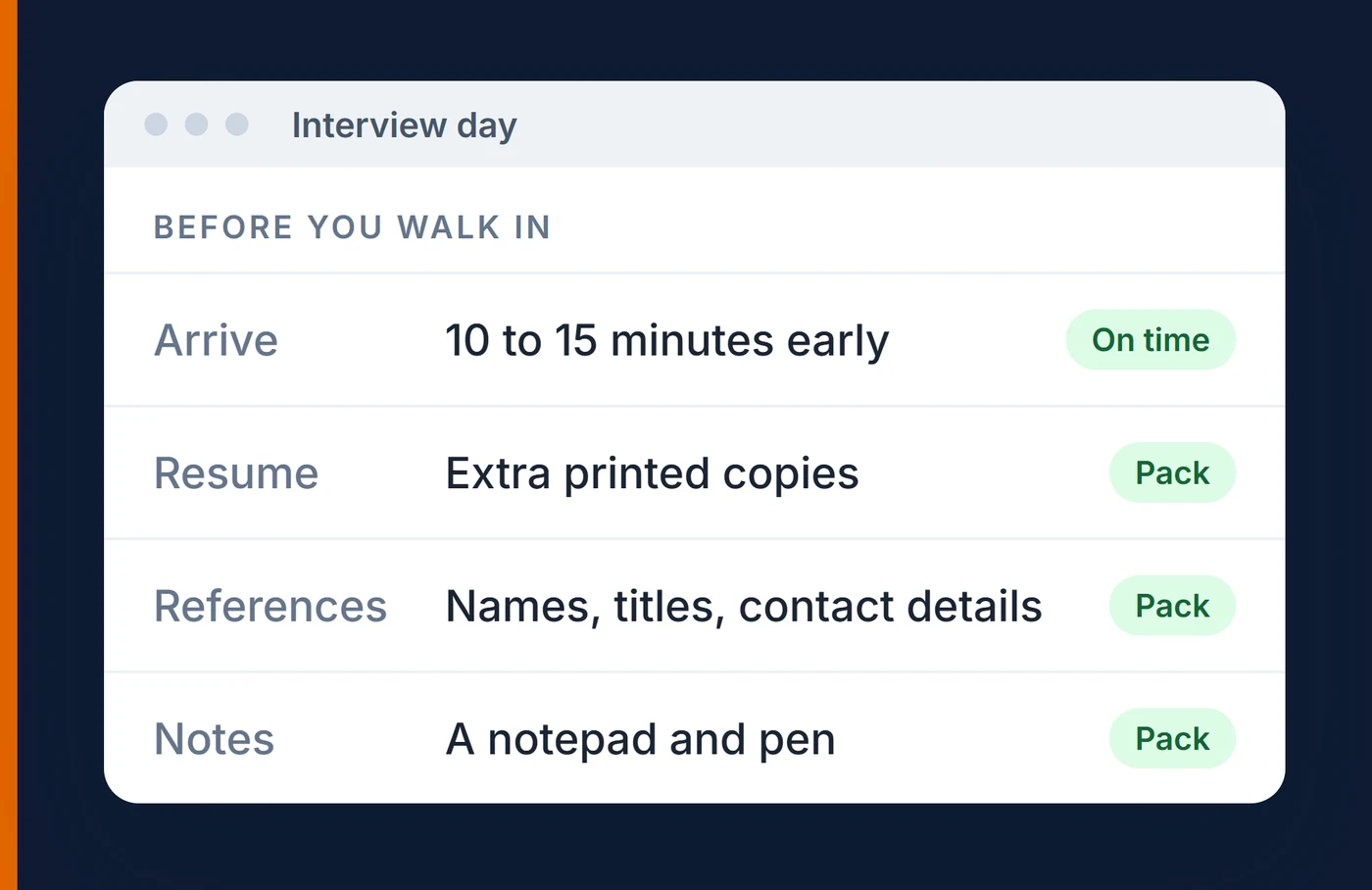
- Extra printed copies of your resume, in case another interviewer joins
- A list of references with names, titles, contact details, and how you know each person (and tell your references ahead of time that they may be contacted)
- A notepad and pen for a few short notes, without letting note-taking pull you out of the conversation
- Your list of questions
When to arrive. Plan your route the day before. Check public transit schedules, or look up the drive and the parking near the building, and leave extra time for traffic. Aim to arrive 10 to 15 minutes before your scheduled time. That gives you room to settle in, use the restroom, and collect your thoughts. Much earlier than that can disrupt the interviewer’s schedule, so if you get there very early, wait nearby.
Video and phone interviews
Everything above still applies when the interview happens on a screen or over the phone. A few details change:
- Test the technology. Open the meeting link ahead of time, check your camera and microphone, charge your device, and join a few minutes early.
- Find a quiet room. Choose a spot with a plain background and good light, and silence your notifications.
- Look at the camera. On video, looking into the camera, not at the faces on your screen, is what comes across as eye contact.
- Have a backup. Keep the interviewer’s phone number handy in case the connection drops.
In the room
Confidence and body language
Your body language is part of your answer.
- Offer a firm handshake (not a crushing one) and a smile to each person you meet, and again when you leave.
- Make eye contact while you speak and while you listen, without staring. On a panel, look at the person who asked the question, then include the others.
- Sit up straight. Slouching or leaning back can read as disinterest.
- Show interest. Listen closely, respond to what the interviewer actually says, and let your enthusiasm for the work come through.
Nerves are normal. It’s fine to pause and say “Let me think about that for a second.”
Answer with the STAR method
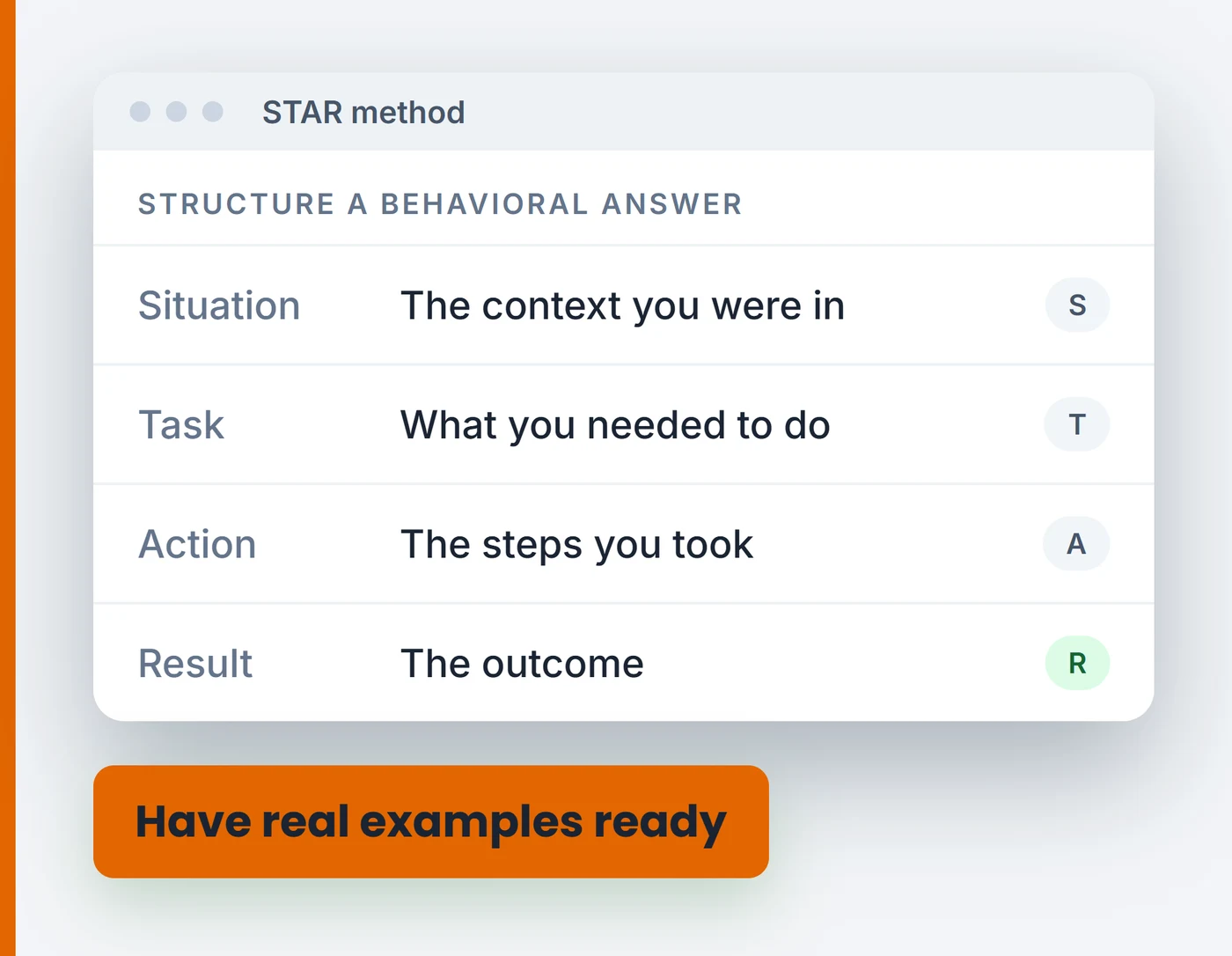
For behavioral questions, the STAR method keeps your answer clear and focused:
- Situation: the context you were in.
- Task: what you needed to do.
- Action: the steps you took.
- Result: the outcome.
Spend most of your time on the action, and say “I” rather than “we” so the interviewer knows what you personally did. Then finish on the result.
Here’s a sample outline for “Tell me about a time you worked under a tight deadline.” It’s a made-up example, so swap in a story of your own.
- Situation: Two days before a client presentation, the teammate preparing half the slides was out sick.
- Task: I had to finish the full deck on time without dropping my other work.
- Action: I listed what was left, asked my manager which sections mattered most to the client, built those first, and asked a colleague to check the numbers before the meeting.
- Result: We presented on schedule, and the client approved the next phase. Since then I keep shared files organized so anyone on the team can pick them up.
That last line, what you changed afterward, shows you learn from your work. For more on what interviewers are listening for, see what hiring managers wish you knew about job interviews.
After the interview
Send a thank-you note
Within 24 hours, send a short, personalized thank-you email to each person who interviewed you. Thank them for their time, mention something specific from the conversation, and restate why you’d be a good fit.
Subject: Thank you for today’s interview
Hi [Interviewer’s name],
Thank you for taking the time to talk with me today about the [job title] role. I enjoyed hearing about [a project or topic from the conversation], and it made me even more interested in joining the team.
Our conversation about [a challenge they mentioned] reminded me of [a brief, related experience of yours]. I’d be glad to bring that experience to the role.
Please let me know if you need anything else from me. I look forward to hearing about next steps.
Best regards,
[Your name]
Change the bracketed parts for each interviewer so no two notes are the same.
Follow up on next steps
Before you leave the interview, ask about the timeline: “When can I expect to hear back about a decision?” and “Is there any other information you need from me?” The answers tell you when it’s reasonable to follow up.
If that date passes with no word, send one short, polite email asking whether there’s an update. Keep applying elsewhere in the meantime. And if the answer is no, our guide to turning job rejections into opportunities covers what to do next.