How Recruiters Really Read Your Resume (and What Makes Them Stop)
Recruiters read a resume in passes: a quick scan of the top, titles and dates, then a closer read. What each pass checks and what ends it early.

A recruiter doesn’t read your resume from top to bottom the way you wrote it. They read it in passes. The first pass takes a few seconds and covers the top of the page: your name, your summary, your current job title, and the dates next to it. If that pass suggests you could do the job, they slow down and read the rest. If it doesn’t, they move on to the next resume.
So the order of your resume matters as much as what’s in it. Here’s what a recruiter looks at in each pass, and what makes them stop reading.
Before a person sees it: keywords and the ATS
Many companies use an applicant tracking system (ATS) to manage the volume of resumes they receive. It scans each resume for keywords and phrases that match the job description, which helps recruiters get through the first screening faster.
Start with the posting. Mark the words that repeat or get emphasis: job titles, tools, certifications, skills. If the posting asks for “project management” and “stakeholder reporting,” and you have that experience, those phrases should appear in your resume. Your skills section and your most recent role are the natural places for them.
Then read it again as a person would. Keywords need to sit inside real sentences. Compare:
- “Project management, stakeholder management, project planning, project delivery”
- “Managed a six-month CRM rollout across three teams, with weekly stakeholder reporting to the operations director”
The first line is keyword stuffing, and it reads that way. The second has the same keywords and also tells the recruiter what you did. Keep the format simple as well: standard section headings and plain text, so the software and the recruiter can both find what they need.
The first pass: the top third
The top of the first page does most of the work. Before anyone scrolls, it should say what you do and why you fit this job.
That’s the job of your summary. A summary written for every job usually says nothing:
Results-driven professional with strong communication skills seeking a challenging role.
A summary written for this job says what you offer:
Customer success manager with five years in B2B software, leading onboarding for accounts of 50 to 500 users. Built the renewal playbook my current team still uses.
Two or three lines is enough. Rewrite it for each posting so the first thing the recruiter reads lines up with what they’re hiring for. Put your most relevant skills and achievements near the top instead of saving the best for page two. If the recruiter only gives you a few seconds, your strongest material should be in those seconds.
The first pass: titles, dates, and your current role
Next, the eye drops to your experience and lands on the parts that stand out visually: job titles, company names, and dates. In that quick look, a recruiter is working out three things.
- What you do now. Your current or most recent role carries the most weight. Make sure its title and first bullet point connect to the job you’re applying for.
- How you’ve progressed. Your run of job titles shows your career path. Each title should accurately reflect your responsibilities and level.
- Whether the dates add up. Recruiters use dates to read your work history. Give accurate ones, in the same format for every role. A discrepancy raises questions you won’t be there to answer.
Layout that survives a quick scan
A fast first pass only works if the layout lets it. A clear, professional layout also says something about your attention to detail before the recruiter has read a word.
- Fonts. Stick to a standard font such as Arial, Calibri, or Times New Roman, at 10 to 12 points. Skip decorative fonts that are hard to read.
- Headings. Use plain section headings like “Experience,” “Education,” and “Skills” so the recruiter can jump to what they’re looking for.
- Spacing. Keep margins, spacing, and alignment consistent from top to bottom.
- Bullets. Use short bullet points under each role, not paragraphs. A bullet can be taken in at a glance.
The closer read: the sections that get attention
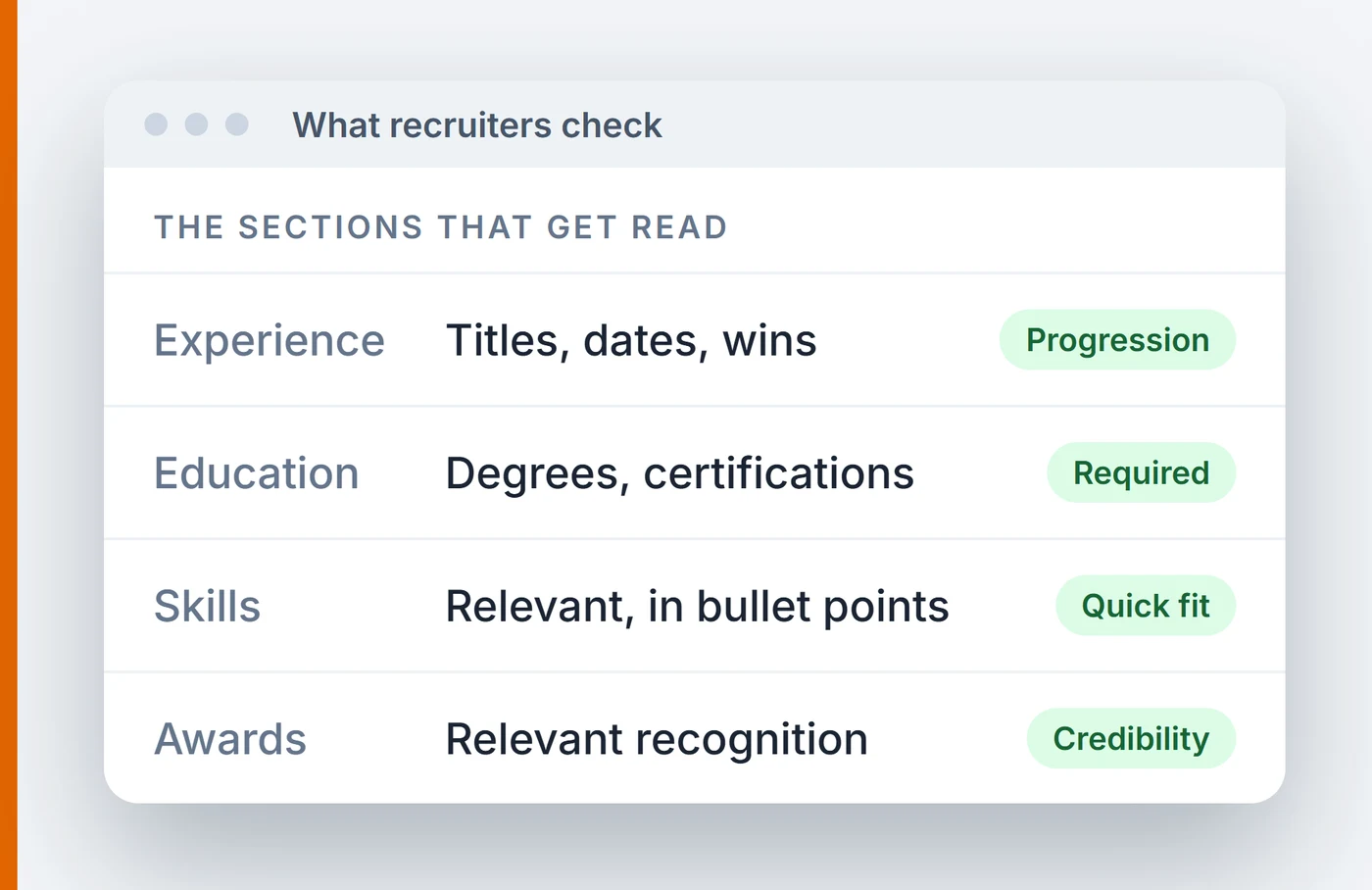
If the first pass goes well, the recruiter reads properly. Now they’re checking whether the details back up what the top of the page promised.
Employment history. For each role, give the job title, company, dates, and a few bullet points on what you achieved, not only what you were responsible for. Lead with the experience most relevant to this job.
Education and certifications. These get close attention when the job requires them. List the institution, the degree or certification, and any coursework, projects, or distinctions that relate to the role.
Skills. This is where a recruiter checks for specific abilities: technical skills, software, languages. List them as bullet points, and make sure the important ones also show up in your experience, where you can show how you used them.
Achievements and awards. Include professional recognition and significant accomplishments that relate to the job. They’re concrete evidence of past success.
Proof, not claims: numbers and transferable skills
What turns a closer read into an interview is evidence. Anyone can write “increased sales.” Fewer people say by how much. Here’s the difference in two sample bullets:
- Before: “Increased sales.”
- After: “Increased sales by 20% within six months.”
- Before: “Improved customer satisfaction.”
- After: “Implemented a new customer feedback system, resulting in a 15% increase in customer satisfaction ratings.”
Each “after” line tells the recruiter what you did, how, and what changed. If you don’t have exact percentages, use the figures you can stand behind: team size, budget, number of clients, turnaround time. If a result can’t be measured, describe its specific effect on the organization, the client, or the team. Our resume writing guide covers how to turn a list of duties into results like these.
Transferable skills. If you’re changing industries or roles, the closer read is where you make your case. Communication, problem-solving, project management, leadership, and time management carry across jobs, but only when you show them in action. “Strong communicator” is a claim. “Ran the weekly update for a 12-person team across two offices” is proof. The same goes for adaptability: one example of learning a new system, tool, or industry quickly does more than calling yourself adaptable.
What makes a recruiter stop reading
Recruiters have seen a lot of resumes, and they’re quick to spot the problems that end a read early.
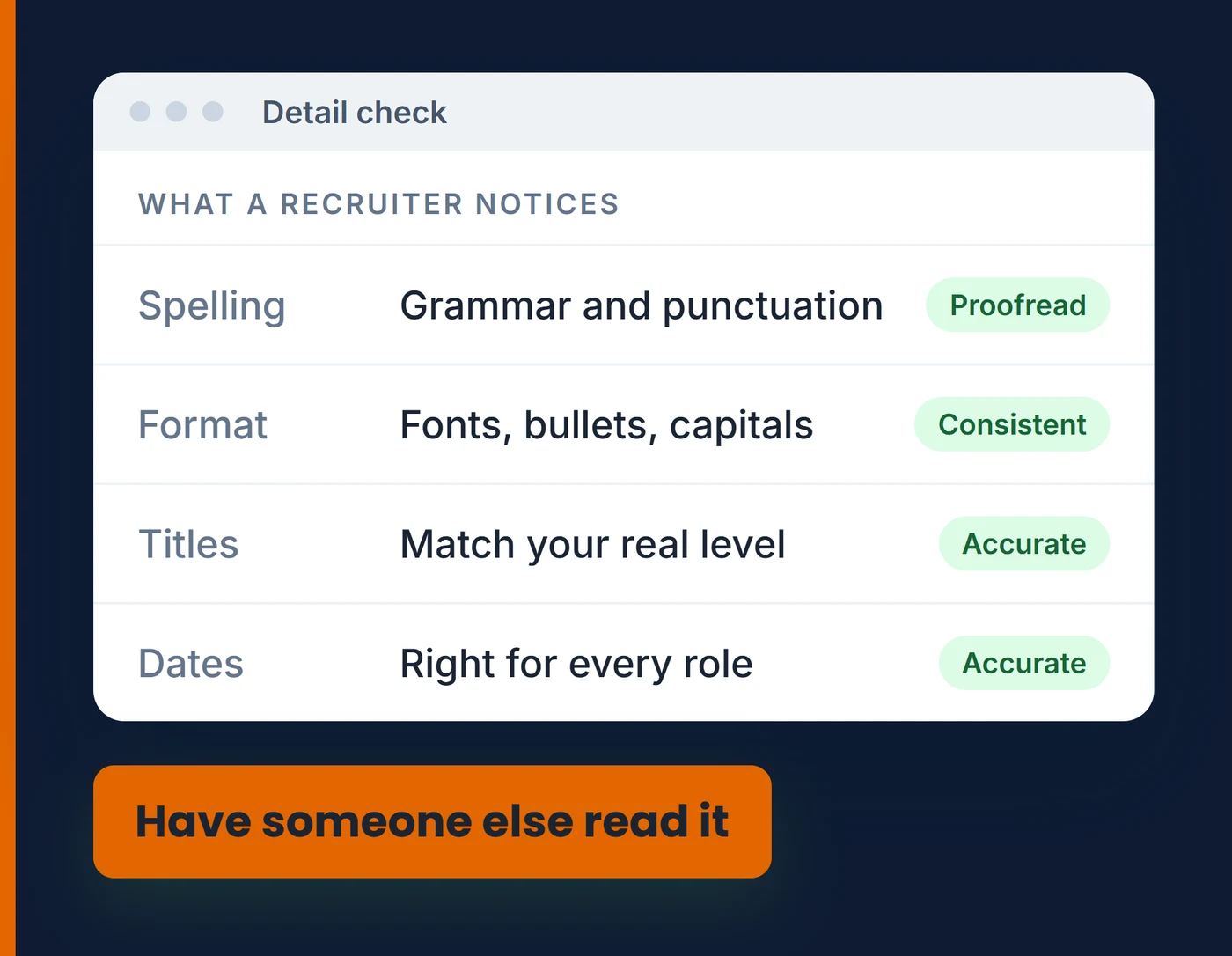
Errors. Spelling, grammar, and punctuation mistakes suggest a lack of care, in a document you had all the time you wanted to check. Proofread it, read it aloud, then have someone else read it.
Inconsistency. Fonts, indentation, bullet points, and capitalization should match throughout. A mix of date formats, or a bullet style that changes halfway down, makes the resume look rushed.
Titles and dates that don’t hold up. Anything inaccurate or unclear in your history raises questions, and the easy answer for a recruiter is to move on.
Generic language. Phrases like “team player” and “detail-oriented” appear on so many resumes that they blur together. Replace each one with something specific you did.
Irrelevant or outdated information. Old roles, lapsed certifications, or skills unrelated to the job pull attention away from the parts that matter. Cut anything that doesn’t support your case for this role.
For less obvious problems, see 10 resume mistakes you didn’t know you’re making.
Read it the way a recruiter will
Before you send your resume, put it through the same two passes. First, look at the top third for a few seconds, then look away. Could you say what this person does, what their current role is, and why they fit this job? If not, fix the top before you polish anything else.
Then do the closer read with the job posting beside you. Check that the posting’s key terms appear in your resume, that every important claim has a number or an example behind it, and that your titles and dates are accurate and consistent. A resume that gets through both passes earns the next step: a call to talk.