The Art of Negotiation: How to Secure the Salary You Want
Salary negotiation step by step: know your numbers, answer the expectations question, counter the offer, and get the final terms in writing.

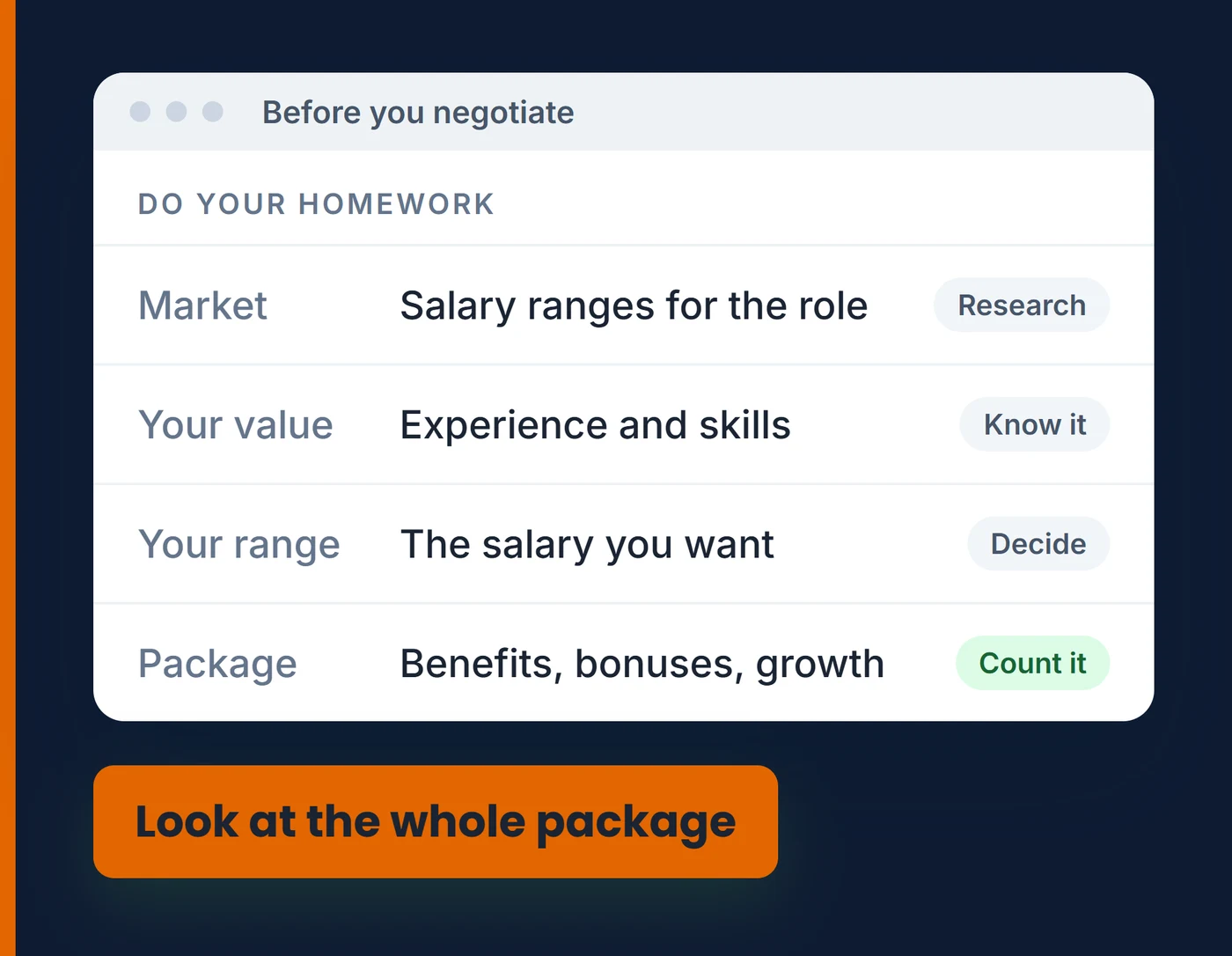
Most of a salary negotiation is decided before you say a word. By the time an offer arrives, you should know what the role pays in your market, the number you’ll ask for, and the point where you’d say no. Without those three things, you end up reacting to whatever number the employer names.
Negotiating isn’t a fight. It’s a conversation about what the job is worth. Here’s how to handle each stage in the order it happens, with a short section on raises at the end.
Before the offer: know your numbers
Start with the market rate for this role, at this level, in this location. If the job is remote, ask how the company sets pay for remote staff. Useful sources include salary surveys, job postings that list pay, and people in your field who will tell you what they earn or what they’ve seen offered. Look for a range, not a single figure, and be honest about where your experience puts you in it.
Then decide three things:
- Your target. The salary you’ll ask for. Make it ambitious but defensible, something you can back with your research and your record.
- Your walk-away point. The lowest offer you’d accept. Decide it now, while you’re calm, based on your expenses, your current pay, and the market.
- What else matters. Base salary is one part of the package. Rank the rest: bonus, benefits, retirement, paid time off, remote or flexible work, training, title, start date. If salary stalls later, this list tells you what to ask for instead.
Next, write down why you’re worth your target. Education, experience, certifications, and training all count, but results count more. List three or four specific accomplishments (a project you delivered, a process you fixed, a team you led), then turn them into a two- or three-sentence pitch about what you’ll bring to this role. Practice it out loud until it sounds natural.
The employer controls the budget, so they start with more power. Knowing the market and your own value is how you even that out, and it lets you walk in confident instead of apologetic.
When they ask for your salary expectations
This question often comes early, in a recruiter screen or first interview, before you know the full scope of the job. Our guides to acing your next interview and what hiring managers wish you knew cover the rest of those early conversations.
If it’s early and you don’t know enough yet, it’s fair to ask for their range first:
I’d like to learn a bit more about the responsibilities before I put a number on it. Could you share the range you’ve budgeted for this role?
If they press, or you’re further along, give a researched range. Set the bottom of it at or above your target, so that even an offer at the low end gets you your number.
Based on what I’ve seen for similar roles in [city or market] and my experience with [key skill or result], I’m looking for something in the range of [$X] to [$Y]. I’m open on the exact figure depending on the full package, including bonus and benefits.
Keep the focus on what this role is worth, not on what you earn now.
When the offer arrives
Thank them and say you’re excited. Then ask for time. Don’t accept on the spot, even if the number looks good. You want to read the whole offer, check it against your numbers, and plan your response.
Thank you, I’m really excited about this role and the team. Could you send the full offer in writing? I’d like to review the details and get back to you by [day].
This is a good moment to negotiate: they’ve decided they want you, and nothing is signed. While you review, look past the base salary to the bonus, benefits, time off, retirement, start date, and remote policy, and ask about anything unclear.
Notice how the company talks about the process, too. Organizations and cultures differ in how they expect negotiation to go, so match their tone.
Making your counteroffer
Open on a positive note. A good counter has four parts: enthusiasm for the job, one clear number (your target), the reasons behind it, and a direct ask. Keep it short.
Email lets you lay out your case carefully, and a call lets you hear how they react. If you counter by phone, follow up in writing.
Subject: Offer for [job title]
Hi [Name],
Thank you again for the offer. I’m excited about joining [Company] and about [a specific project or goal from your interviews].
Having reviewed the details, I’d like to discuss the base salary. Based on market pay for this role in [location] and the experience I bring in [key area], including [a specific result], I’m asking for a base salary of [$X].
If we can get there, I’m ready to accept. I’m happy to talk it through on a call if that’s easier.
Best, [Your name]
Only include “I’m ready to accept” if it’s true. Once the conversation starts, a few techniques help:
- Argue from value, not need. Market pay and the results you’d bring make a stronger case than your rent or your debts.
- Listen more than you talk. Ask what’s behind their number and let them finish. Whether the limit is budget, internal pay bands, or something else points you toward a solution that works for both sides.
- Stay warm. You’re about to work with these people. Keep your voice calm and your tone friendly.
- Pause after you name your number. Let them respond instead of talking yourself down.
- Share selectively. You don’t have to reveal your current pay or the details of other offers, and never share your current employer’s confidential information to make your case.
When they say “this is our best offer”
Pushback is part of negotiating, not a rejection. Stay calm, don’t get defensive, and ask what flexibility exists. If they move a little, weigh the new number against your target and walk-away point.
If the salary truly can’t move, turn to the rest of your list:
I understand, and I appreciate you checking. I’m still very interested in the role. If the base is at the top of the range, could we look at other parts of the package? A signing bonus, extra paid time off, or an earlier salary review would help close the gap.
Things you can ask for when the base is fixed:
- A signing bonus, a one-time payment that leaves the base where it is
- Start date, if you need time off between jobs
- Title, if it reflects the work and helps your next move
- Review timing, an earlier salary review, with the date in writing
- Remote or flexible work, with set days or hours
- Paid time off or a professional development budget
Pick the one or two that matter most to you.
Be realistic, too. A small company or a tight budget year may genuinely not have room. If the final offer is still below your walk-away point, it’s fine to decline politely and leave the door open. Deciding that number in advance is what lets you say no calmly.
Closing the deal: get it in writing
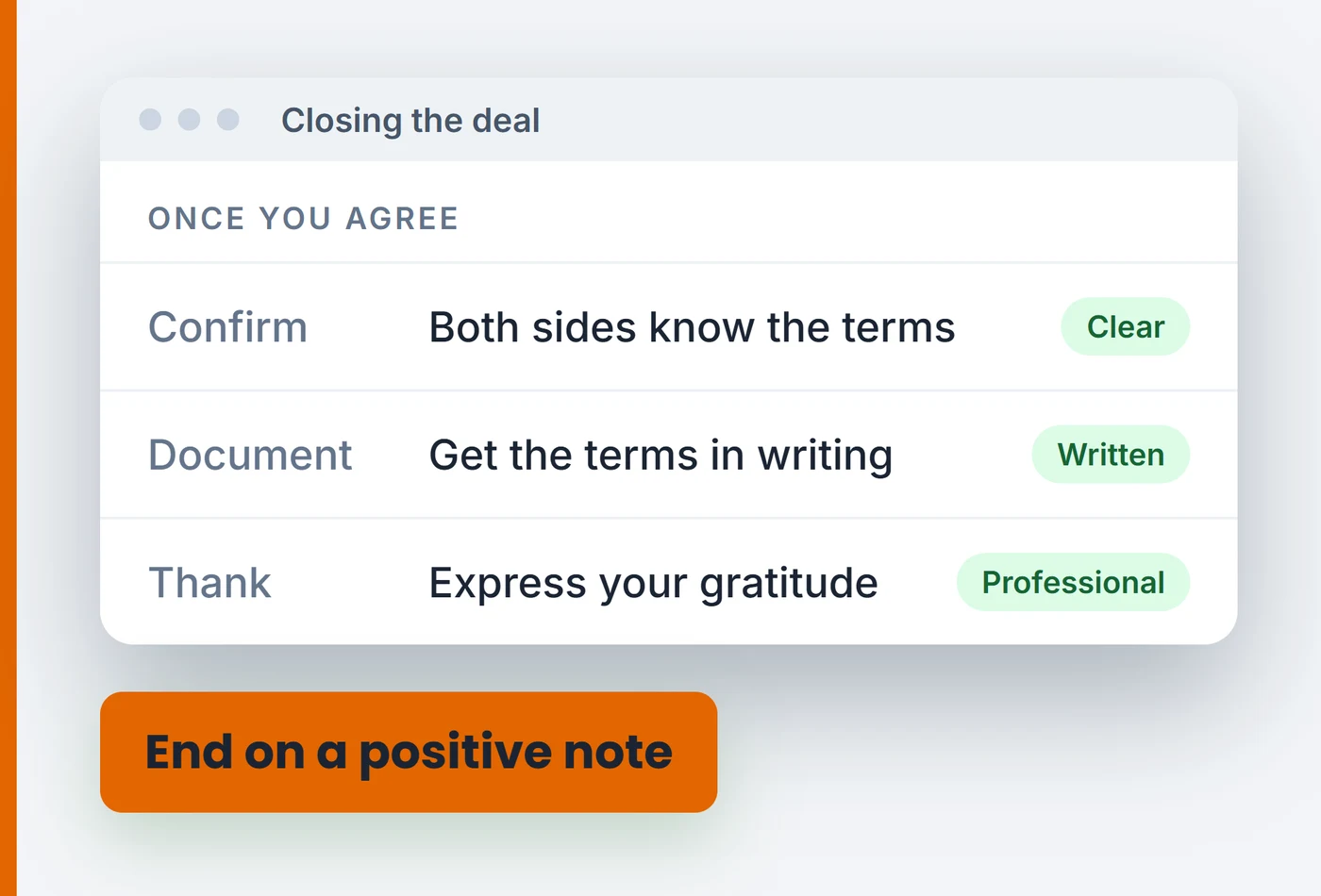
Once you agree, thank them, then ask for an updated written offer that includes every term you discussed. Before you sign, check that each item is there, including anything agreed only in conversation. Don’t resign from your current job until you have the signed offer.
Thank you for working with me on this. I’m happy to accept. Could you send an updated offer letter that includes the base salary of [$X], the [date] start date, and the salary review date we discussed?
End on a positive note. A gracious close sets the tone for your first day.
Negotiating a raise
The same steps apply in a shorter loop. Research what your role pays now, list your results since your last pay change, and pick your moment: your performance review or soon after a clear win, not the middle of a crisis.
Then ask your manager for a meeting, make your case, and name a number. If the answer is no, ask what it would take and when you can revisit it, and confirm that in writing. A plan with a date beats a vague “maybe next year.”
Whether it’s a new offer or a raise, the work is the same: know your numbers, make your case calmly, and get the result on paper.